


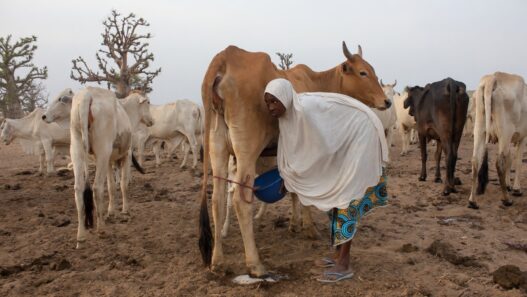

In Yola, northeastern Nigeria, Fulani pastoralists begin their day before sunrise, following routines that have shaped their lives for generations.
Within a Ruga, a traditional Fulani settlement, the morning unfolds quietly. Women prepare food over firewood while children move among cattle, loosening ropes so calves can feed. This process helps stimulate milk production.
For residents, cattle are not just a source of income but central to daily life.
“We contribute immensely to rearing our cattle,” said Nana Firdausi Musa, a Fulani woman in the settlement. “We tie them, take care of them, provide shade, feed them, and take them to the river to drink water before bringing them back. When they are sick, we do our best to treat and care for them.”

Across sub-Saharan Africa, women contribute between 60 and 80 percent of labour in food production, according to the Food and Agriculture Organization. In Fulani communities, their role extends beyond food production to sustaining pastoral livelihoods.
Cattle and cultural identity

The Fulani are among the largest dairy producers in West Africa, but residents say their connection to cattle goes beyond economics.
“Cattle are very valuable to Fulani people,” said Alhaji Bello Ardo, a community elder. “Among all material possessions, aside from human beings, there is nothing I love more than cows, even if they are not mine.”
He said the bond between herders and cattle is often personal.
“Sometimes, the cattle recognize me and come to me. When I call them, they respond,” he added.
Knowledge of animal care is passed down through generations. Children grow up learning how to rear cattle as part of Pulaaku, a Fulani code of conduct that emphasises discipline and responsibility.
For Bello, that connection can be deeply emotional.
“The love I have for a breed of our Pulaaku cattle called Haɓanaye is very deep,” he said. “Even if I have up to 100 cows, I still keep a close watch on all of them. I feel disturbed whenever any of them fall sick.”
Security concerns and perception
Despite their role in food production, many Fulani communities say they feel increasingly marginalised.
Residents point to insecurity, particularly cattle rustling, as a major challenge. At the same time, they say public perception has worsened their situation.
“My complaints as a Fulani living in Nigeria are just a few,” said Nana Firdausi Musa. “We often do not know where to go. In the forests, our cattle are rustled, yet we are labeled as bandits.”
She said the generalisation of Fulani people has created additional pressure.
“Why can’t people understand that not all Fulani are terrorists?” she asked. “I am from the Sulubawa group of Fulani, yet we are all being generalized.”
She called on authorities to work with community leaders to identify those responsible for crimes.
Alhaji Bello Ardo also warned against stereotyping.
“It is painful to see an entire ethnic group being stereotyped,” he said. “Every ethnic group has individuals involved in crime, but in our case, people make accusations without confirmation.”
Changing environment and future risks
Residents say environmental and economic changes are also affecting their way of life.
Grazing lands are shrinking as farming expands, leaving pastoralists with fewer areas to sustain their herds.
“Looking ahead, we fear that cattle rearing may become history in Nigeria,” Bello said. “Not everyone can afford to rear cattle anymore because grazing lands are disappearing.”
He added that some herders are now forced to move beyond Nigeria’s borders.
“In some cases, Fulani herders are even forced to move as far as Cameroon.”
A tradition under pressure
Despite these challenges, daily life in the Ruga continues.
After breakfast, men lead the herds out to graze, maintaining a cycle that has defined Fulani pastoral life for generations.
But residents say the future of that tradition is uncertain.

For many, the concern is no longer only about sustaining their livelihoods, but whether cattle rearing itself can survive in modern Nigeria.